|
|||||||
 BY BRAND
  
|
Glossary
- HOW TO DETERMINE DOOR HANDING -LEFT OR RIGHT
Door Handing and Lock Handing are not always the same! Determine door handing by standing outside the door. Whatever side the hinges are on will be your lock handing. 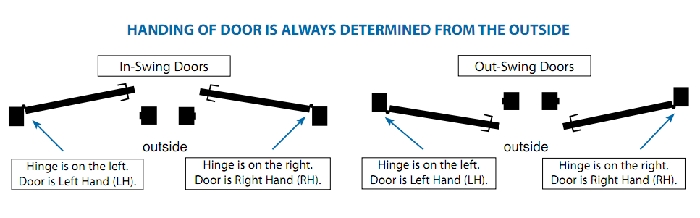 American/U.S. Cylinders Refers to the type of cylinder used with several types of multi-point lock sets. These cylinders are attached to the escutcheon and do not vary in length, but the tailpiece length varies according to door thickness. [Category: Lock Mechanisms Terminology] Backset Backsets for tubular locksets are 2 3/8" or 2 3/4". Backsets for Mortise Locks are most common 2 1/2" or 2 3/4". 2" Backset is available for Baldwin Mortise Locks. Center To Center Tubular Locks require a cut-out in the door as shown. Many doors are factory prepared like this. Typically the center-to-center spacing between the cut-outs is 5-1/2 inches. If this is your case, then most tubular entry locks should fit your door. If you have a different dimension, then a sectional lock may be used. Always verify the center-to center spacing of the lock before ordering. [View Center To Center Diagram] [Category: Door Terminology] Clavos Decorative nails typically applied to the surface of a door. [Category: Door Terminology] Cylinders A portion of a lock where the key is inserted to lock or unlock the set. There are several different kinds common to different hardware sets. [Category: Lock Mechanisms Terminology] Dummy - Full This is a set with inoperable handles on both sides of the door (typically used in conjunction with roller catches, flush bolts or surface bolts). [Category: Lock Terminology, General] Dummy - Single This is a set with an inoperable handle on one side of the door (typically used in conjunction with roller catches, flush bolts or surface bolts). [Category: Lock Terminology, General] Emergency Release This term refers to the capability of a lock to be unlocked from the exterior side in case of an emergency situation. This is an aspect of most interior privacy lock sets. Most hardware provides an emergency release key with privacy lock sets. [Category: Lock Mechanisms Terminology] Entry (Double Cylinder) This is a locking set with operable handles that has a keyed cylinder on both sides of the door (typically used on primary exterior doors). [Category: Lock Terminology, General] Entry (Single Cylinder) This is a locking set with operable handles that has a keyed cylinder on the exterior side of the door and a turn piece on the interior side (typically used on primary exterior doors). [Category: Lock Terminology, General] Eurpoean Profile Cylinders The other type of cylinder used with multi-point lock sets. These cylinders slip through the exterior escutcheon, the door and the interior escutcheon and are held in place by a set screw through the edge of the lock and vary in length for different door thicknesses. [Category: Lock Mechanisms Terminology] Flush Pulls Recessed pulls used on sliding doors such as pocket or bypass doors. [Category: Lock Mechanisms Terminology] Living Finish A "living finish" means that the hardware is not coated, and the finish may change and darken due to oxidation and wear, much as a copper penny will darken and change over time. [Category: Miscellaneous Terminology] Mortise Bolt A locking mechanism that is separate from the latching mechanism and is operated by a turn piece. It is commonly used for interior applications to provide privacy on bedroom and bathroom doors. [Category: Lock Mechanisms Terminology] Mortise Cylinders Mechanisms that are threaded into mortise locks, secured by a set screw through the edge of the lock and vary in length for different door thicknesses. [Category: Lock Mechanisms Terminology] Mortise Lock This mechanism integrates the locking and latching mechanisms into a single cartridge style lock. The mortise lock is available in a variety of functions such as entry, patio, privacy and passage. [Category: Lock Mechanisms Terminology] Multi-Point Lock Mechanisms Mechanisms that latch the door at several points along the length of the door instead of a single point in close proximity to the handle. Multi-point locks are provided with French doors made by most of the major window manufacturers. Due to the variety of multi-point sets available, we recommend that a copy or photo of the existing lock trim or a factory drawing be sent to us so our trim can be machined correctly to match the lock in the door. [Category: Lock Mechanisms Terminology] Ornamental Hinge Strap A decorative piece of metal applied to the surface of a door to mimic a strap hinge. [Category: Hinges Terminology] Passage This is a non-locking set with operable handles (typically used on doors that do not require security or privacy such as closets, laundry or utility rooms, pantry, mechanical rooms and so on). [Category: Lock Terminology, General] Patio This is a lock set with operable handles that is locked by a turn piece from the interior side, but has no keyed access from the exterior (typically used on secondary exterior doors). [Category: Lock Terminology, General] Privacy (Mortise Bolt or Mortise Lock) This is a locking set with operable handles that is locked by a turn piece from the interior side and can be unlocked by an emergency release key from the exterior side (typically used on bedroom and bathroom doors). [Category: Lock Terminology, General] Privacy (Spring Latch) This is a locking set with operable handles that is locked by a push button on the escutcheon from the interior side of the door and can be unlocked by an emergency release key from the exterior side (typically used on bedroom and bathroom doors). [Category: Lock Terminology, General] Rim Cylinders Mechanisms used in dead bolts that are mounted with screws from the opposite side of the door. They do not vary in length, but the mounting screw and tailpiece lengths vary according to door thickness. [Category: Lock Mechanisms Terminology] Spring Latch A latching mechanism operated by the handles. [Category: Lock Mechanisms Terminology] Strap Hinges Hinges that have one leaf applied to the surface of the jamb and one leaf attached to the surface of the door. [Category: Hinges Terminology] Swing Cover The flap that covers the cylinder or the emergency release access. [View Trim Diagram] [Category: Lock Trim Terminology] Note: This glossary of terms is provided to the consumer as a service, is provided as-is, and is subject to change. Terms here are provided by LocksUSA.com and are in no way complete or definitive. Please verify all terms with your salesperson, locksmith, or contractor. |
||||||


our showroom customer service shipping info testimonials door handing & glossary contact us privacy policy
|
